
Evolution of the Artistic Canon: A Meme's Eye Perspective
Given as part of Stretching the Canon: Working Class and Queer British Art Today, Whitworth, Manchester
6th September 2024
“We are all curious little collages, weird little planetoids that grow by accreting other people’s habits and ideas and styles and tics and jokes and phrases and tunes and hopes and fears as if they were meteorites that came soaring out of the blue, collided with us, and stuck.” Douglas Hofstadter
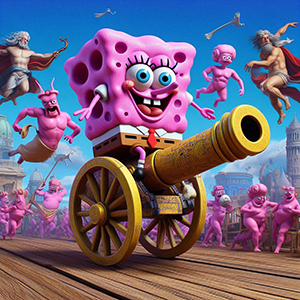
Introduction:
What makes us think that our era is less fallible to the criticism of future generations than any other?Works contained in the current canon have earned their place because they have demonstrated longevity of appeal and influence. The Western artistic canon is subject to the same Darwinist rules of evolution by natural selection as everything else in nature. Drawing on the work of Daniel Dennett, Richard Dawkins, Marvin Minsky, and my own project Shonky: The Aesthetics of Awkwardness, I’ll reflect on the ways in which the canon is formed both top-down and bottom-up in a process of constant revision that evolves over time in the context of selective pressure. Taking a meme’s eye view of canon formation may contribute fresh understanding to the discussion.

Background:
I recently sat as a member of the Arts Council Collection Acquisitions Committee, which gave me an insight into the nature of the culture industry and its influence on the formation of the canon. I often think about the canon as being like the Borg in Star Trek, assimilating and spreading its way through the universe. Most art produced in a given era will either never be seen or will be seen briefly and then disappear or get destroyed. Some art, and some artists, are easily absorbed into the canon, whilst others resist assimilation, taking longer to be acknowledged, or require other critical structures to grow around them before they can find their place. Others, if their work doesn’t succumb to destruction, can be exhumed.
A big part of my project as a visual artist has been to address the question of where my work lives in the world and to take ownership of that conversation. In an attempt to build a world for my work I have constantly adapted it for its survival – expanding from painting and pictorial discourses to include sculpture, performance, video, installation, spatial design, academic work in the form of a PhD, collaboration, teaching, and curating. I have exhibited in a range of contexts; commercial galleries, project spaces, public and private institutions, and online. My work has been collected by museums. But because of the curious, wide-ranging, and transgressive nature of my oeuvre it has not easily found a home in existing categories. I, and my work, have not (yet) been “borg-ed.”
Shonky:
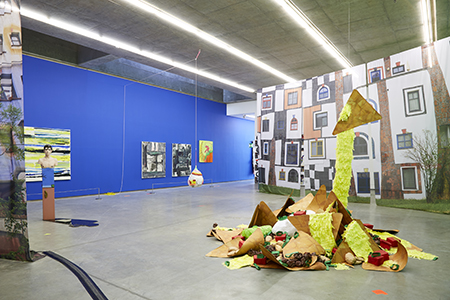
Of relevance to STRETCHING THE CANON is Shonky: The Aesthetics of Awkwardness, which I curated for Hayward Gallery Touring in 2017. The exhibition grew out of my thinking about production values – precise imprecision, the use of cardboard, architectural models, drawing, stand-ins, attempts, stabs, workarounds, kludges, dissonance, asymmetry, and bad taste. In painting terms this may include showing the working, embracing pentimenti, and freeing painting from the verbal (i.e. thinking visually).
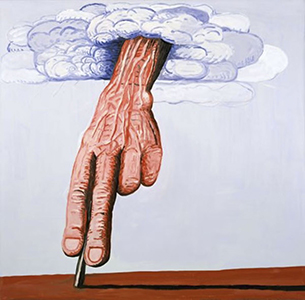
In Roger Malbert’s catalogue introduction to Shonky he included the word ‘shoddy’ in a list of adjectives associated with shonkiness, but he was wrong. The shonky is “bad” in the sense that paintings by Philip Guston are bad, but shonkiness is not shittiness. Bad painting is not technically bad, poor quality, lazy, or crap. Its ‘badness’ is indexed inversely to classical drawing. In this sense it pivots against the canon. In an artistic design matrix “badness” is a move that can be made, in a complimentary way to “goodness.”
I defined shonky back then as a tendency that favours the provisional over the slick, which favours the approximate, the punk, and the out-of-fashion above the over-professionalised. Shonky prizes the awkward, the misshapen, the imbalanced, and the perverse over the shiny, the sleek, and the perfect. Subsequent research has led me to think that shonky is better defined as to do with the makeshift. The shonky uses what’s at hand, putting it under inventive pressure by employing playful strategies borrowed from improvisation. The architect Charles Jencks defines this as ad-hoc. Ad-hocism and shonkiness share similar methods of construction – a frenetic charge of visual devices shoved together to create new admixtures.
Changing the canon:
Did Shonky change the canon? It brought certain artists and artworks to the attention of artists and art students who may otherwise not have encountered them. Furthermore, it made new associations between artists, and artworks, which may not have previously been considered - showing a hidden pattern of behaviour, and naming it, in a way that has been proven to have value. However, with distance of time I can see limitations to shonky’s claims on canon formation.
I put forward the idea that the canon can be revolutionised by the individual artist or curator, but this is not true. The way that an artist goes about gathering an armoury of artistic devices, strategies, tools, and thinking mechanisms, and builds an artistic family tree for themselves would be better defined as a ‘repertoire’. Each artist is responsible for forming this artistic identity kit. The voice of the artist – the author - is an averaging, merging, and recombinance of this repertoire into something that feels whole and new. By contrast the canon is formed by the group. It is a collectively shared pool of references. By its nature the canon is concerned with making a family tree of art that can appeal to a broader parliament.
In Shonky I included artists such as Niki de Saint Phalle, Hundertwasser, Andrew Logan, and the architects Arakawa and Gins, who for me as an artist are creative touchstones but who for others may be artistically irrelevant. That said, Shonky anticipated a resurgence of interest in Niki, notably in her 2021 retrospective at MoMA PS1 in New York. Although I can’t claim responsibility for this reassessment of de Saint Phalle’s legacy, the timing does point to a cycle of reconsideration, reassessment, and revisionism that goes on with regard to artists from decade-to-decade, era-to-era. And this cycle (these cycles) feed back onto each other and get edited over time like rain pouring over sandstone, wearing down the narrative of artists and works into the art historical canon that we receive. It is a process of gradualism.
To return to Philip Guston, the canon ends up absorbing him and his work when it is proven over time that his innovations break ground for others to build new lines of enquiry upon, and his work is a constant go-to for other artists seeking inspiring strategies. His breaks with tradition are more than novelties.
The canon and taxonomy:
So how did we arrive at the existing artistic canon? The Grand Tour is a good way into beginning to understand canon formation. During the seventeenth, eighteenth, and nineteenth centuries, upper class young gentlemen toured Europe to view and experience art, architecture, and music, bringing back with them ideas for the creation of new works, and/or newly cultivated tastes for acquiring and commissioning work. Their Enlightenment journeys engaged heavily with Greek and Roman antiquity, and with the Renaissance artworks that were inspired by these sources.
Artists, intellectuals, and collectors sought to establish a canon of standard types and genres, and to hierarchise them: History painting, Portrait painting, Genre painting (scenes of everyday life), Landscape, Animal painting, Still life. The canon was deemed to contain examples of beauty, good quality (in terms of taste and design), and of best practice. This taxonomic approach to culture controlled it and corralled it. It was a process of top-down design, in which the canon was superimposed on the world. Equivalent processes of categorisation went on across disciplines, including Natural History where the Linnaean system of ranking organisms using Latin became standardised. This process was an intellectual equivalent of the enclosure act. The subdivisions of taxonomy are convenient but invented, demanding constant scrutiny to ensure they are not limiting. The pros of this canon were that it created a shared frame of reference, a cultural shorthand, and a common language. The cons of it were that it was Eurocentric, exclusionary, and slow to respond to change.
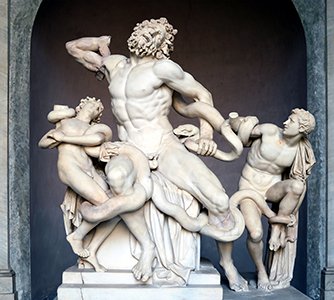
Despite this the canon has had to be revised periodically. The discovery of the sculpture Laocoön and his Sons during excavations in Rome in 1506 forced a correction of the canon. The group of entwined figures struggling with a sea snake presented a radical new insight into classical art, and brought into question existing notions of compositional dynamism, and narrative figuration. The canon was rewritten to accommodate Laocoön, and it went on to influence subsequent sculpture and painting.
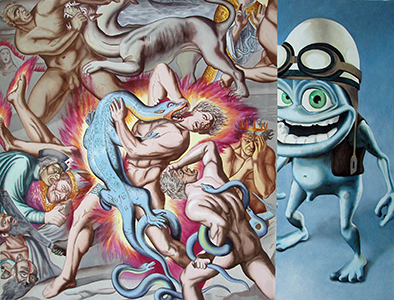
A great example of this is a fresco in the Casino Massimo in Rome by The Nazarenes (kind of German Pre-Raphaelites) featuring a screaming man wrestling a blue serpent, which is wrapped around him and adjacent figures in a way that draws directly up the Laocoön sculpture.
I myself continued to draw on this canonical reference in 2007 when I quoted the fresco in my own painting Here Comes Lorraine Again, juxtaposing it with a rendering of the Crazy Frog.
The discovery of Tutankhamun’s tomb in 1922 had an equivalent effect on the artistic canon, sending shockwaves through designs of jewellery, furniture, interiors, makeup, and funerary monuments. The canon was forced to realign, shuffling its parts to make room for this new discovery and its implications on taste, and available modes.

Biography and the canon:
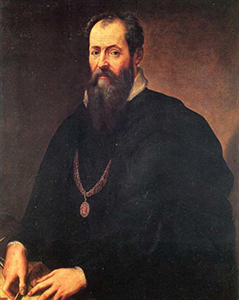
Let me return to the role that curator culture plays in canon formation. Argument about whether or not the canon should be changed is often a question of authorship and whether or not certain people are represented. I saw during my tenure on the Arts Council Collection Committee a rush to rewrite the artistic canon to correct for an historic lack of diversity. The conversation centred upon the identity of the artist, and in acquiring an artwork by them as a means of assimilating their biography into the collection. The canon was being rewritten to make room for the personal account of artists in terms of race, gender, sexuality, class, and so on, rather than identifying gaps in the collection in terms of the taxonomic diversity of artworks and correcting for those. This biographical approach to the canon draws directly on the work of Giorgio Vasari, Renaissance artist and biographer, who pioneered the myth of the artist as genius.
The role of curators in canon formation:
Curators are the bureaucrats of top-down canon formation. They decide who is ordained. Along with the art world journalists, art historians, gallerists, and collectors, they are the gatekeepers of the canon. They decide who makes the cut because they write the official history of art. And, in this top-down aspect of forming the canon, they are the revisionists too. In her primer Glittering Images Camille Paglia gathers together her own artistic canon. It’s subtitle A Journey Through Art From Egypt to Star Wars emphasises the refreshing way in which she cuts across time, media, geography, language, religion, and culture to recast the canon to account for film and the Internet.
Artists can be absorbed into the canon later on their careers, like Phyllida Barlow, Louise Bourgeois, Lubaina Himid, and Bobby Baker. This expansion is often driven by the market wanting more of a certain thing that it has run out of, so it starts looking in the nooks and crannies for more.
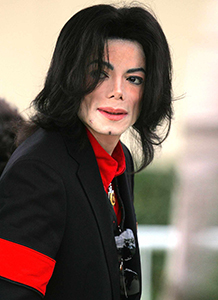
Artists can also be removed from the canon, often because of shifting tastes and morals. People these days are squeamish about the work of Eric Gill and Michael Jackson because of the nature of their relationships with children and minors.
Artists can be factored into the canon but may not stick. My art historian friend Sue Russell has been researching the work of seventeenth century Dutch artist Herman van Swanevelt for several years, but his place in art history is still in motion. We have yet to see which of the artists currently being written in to art history will demonstrate longevity of appeal and importance. Time is the stress test. Curatorial taste can only reach so far.
Artists can be ‘cancelled’ but still remain in the canon because their work is drawn on by practising artists and enjoyed by audiences. The work of Balthus is still popular despite the controversies of his personal life. In all these examples the biography of the artist and their work are inseparable. Ultimately it is hubris on the part of curators to imagine that any corrections they make to the canon now will be future proof.
The myth of the artistic genius:
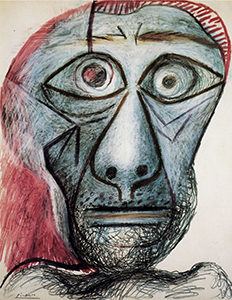
One of the issues at the heart of this debate is the role that genius plays in canon formation. The canon includes work by those humans that we consider geniuses but more importantly it also contains works by lesser-known people as well. Arshile Gorky spent most of his career working through the work of others until something shifted. The canon is not just a greatest hits. Dennett argues that a Bach or a Picasso will emerge regardless of those particular individual authors because what is really at stake is how innovations and mutations amalgamate in new arrangements given enough evolutionary time, and that these amalgamations would have emerged through one or other author given enough time, not just because Picasso or Bach existed.
These new combinations of artistic parts are radical enough to show up as new artistic prototypes, and therefore they are worthy of being considered canonical. The computer scientist Marvin Minsky debunks the myth of genius when he says:
“It’s not enough to learn a lot; one also has to manage what one learns. Those masters have, beneath the surface of their mastery, some special knacks of “higher-order” expertise, which help them organize and apply the things they learn. It is those tricks of mental management that produce the systems that create those works of genius.”
Picasso’s work is canonical not because he was a god-like genius, but because he was a designer with some clever tricks and thinking tools, that he combined in a novel way, which others could scaffold off to make further innovations.
The canon as meme pool:
“What mutations has the artist put on the tradition to make it fitter for purpose?” should perhaps be the question that we ask when deciding what works enter the canon. In this sense the canon, by its very nature, is queer since all artmaking is a process of memetic engineering in which cultural forms are made strange and new.
So, if the canon is not only a collection of artists’ biographies, then what is it? The canon is a seedbank, or a data bank of technologies, a cache of best practice in terms of artistic thinking tools and strategies. The canon is a commons of Intellectual Property. It is a repertoire of ‘imagination prostheses,’ a list of good examples from which we can catalyse the production of new artworks. Artists can go to the canon and take from it, borrowing images and ideas like a library, taking cuttings from which they can grow entire new artworks, or bodies of work. Or to put it another way the canon is a meme pool.

What does meme theory have to say about canon formation?
Culture is not stored in the genes; it is stored in the memes; the canon is a meme pool for art in an analogous way that the gene pool is for biology. In his 1976 book The Selfish Gene Richard Dawkins put forward the meme to describe a unit of cultural replication. Memes are little chunks of cultural information that get repeated (if they are successful) and thus transmitted across time. Memes often cluster together into larger chunks – memeplexes – in order to gain a selective advantage, to replicate better.
Do we acquire ideas or do ideas acquire us?
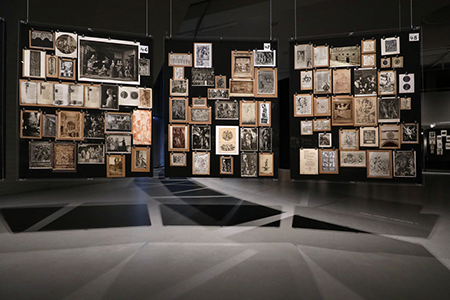
Seeing the spread of culture from a meme’s eye perspective, as opposed to a scale of human authorship, raises questions about which works should be included in the canon. In his Mnemosyne Atlas the art historian Aby Warburg sought to create a family tree of images. In a series of panels, he gathered examples from different periods of history to demonstrate the transmission of an image, symbol, or cluster of motifs across time. The Mnemosyne Atlas shows that we do not acquire ideas, they acquire us. To quote Susan Blackmore “memes find a home in a person’s repertoire of arguments, beliefs and behaviour.” Memes often piggyback off our biological imperatives to gain an advantage over other memes. This is where biography sneaks into the discussion by stealth. The meme pool is a highly competitive environment, and entrance into the meme pool depends on the memes grabbing our attention and retaining it.
Dawkins defines a good meme as possessing three qualities: fecundity, fidelity, and longevity. The Paisley Pattern is a great example of a successful meme. Originating in Persia and travelling the Silk Road for centuries, before being imported to Europe and then going global, the teardrop-shaped motif finds a place in different cultures, religions, and tastes. Acquiring geographical mutations in Azerbaijan, and Kashmir, and then transmitting under successive regime changes of Moghul, Hindu, and Islam, the boteh or buta is a highly infectious meme, capable of adapting to shifting environmental conditions, whilst retaining its strongly identifiable cell-like phenotype. To quote Aaron Lynch, “when a meme achieves situation-invariant replication, it stands a better chance of spreading recursively enough to become a mass thought contagion.” What memes teach us is that canonical forms are not authored by humans. We are simply the hosts for symbionts that require us to transmit them. Our vanity means that we perceive that we invented and own these canonical forms.

Evolutionary speed, memes, and the canon:
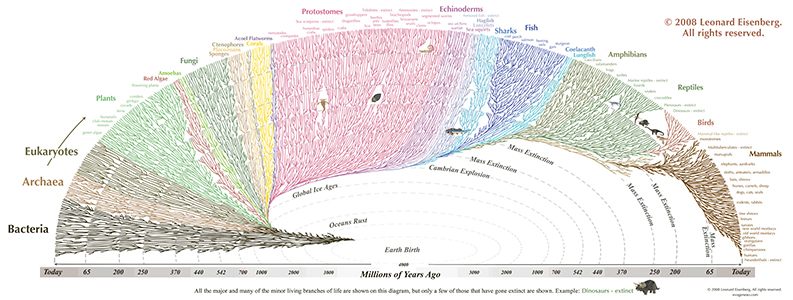
"Evolution is clever than you are" Francis Crick reminds us. Or to put it another way “The process of natural selection, though mindless, produces designs that are more cunning and devious than most humans can imagine” – Daniel Dennett. The only law of the canon is that it appears to be static, but it is constantly evolving, and at an imperceptible rate. Cultural evolution is very fast compared to biological evolution. Artistic phenotypes can evolve in a number of years, compared to the eons of time that animal bodies, plants, and planets take to form. Evolutionary time teaches us that the canon emerges bottom-up as much as it is engineered top-down by curators and art world professionals.
Conclusion:
Every generation questions the artistic canon that they receive from history. And every generation thinks that they can revise the canon, streamlining it and perfecting it for others. This view is seductive but false. In reality, the artistic canon forms at a speed invisible to humans, i.e. at the speed of evolution. The canon is formed through complex interactions between bottom-up design (the spread of memes, the improvisation of artists, the taste of audiences) and top-down design (interventions by curators, art historians, collectors, and journalists). The artistic canon is a commons of thinking tools, artistic devices, memeplexes, and narratives, which can be (re)deployed in the creation of new work. The canon is annealed over time through debate, negotiation, revision, and a series of feedback loops.